Request Free Sample ×

Kindly complete the form below to receive a free sample of this Report

* Please use a valid business email

Leading companies partner with us for data-driven Insights

clients tt-cursor
Hero Background

Fitness Equipment Home Gym Training Market

ID: MRFR/CG/10447-HCR
167 Pages
Snehal Singh
Last Updated: April 06, 2026

Fitness Equipment Home & Gym Training Market Size, Share, Industry Trend & Analysis Research Report Information By Application (Residential and Commercial), Product Type (Cardiovascular Training Equipment and Strength Training Equipment), Demographics (Men, Women, Unisex, and Kids), Pricing (Premium/ Luxury and Mass), End User (Recreational and Professional) Distribution Channel (Supermarkets & Hypermarkets, Specialty Stores, Online, and Others) And By Region (North America, Europe, Asia-Pacific, Latin America and Middle East & Africa) - Forecast Till 2035

Share:
Download PDF ×

We do not share your information with anyone. However, we may send you emails based on your report interest from time to time. You may contact us at any time to opt-out.

Fitness Equipment Home Gym Training Market Infographic
Purchase Options

Fitness Equipment Home Gym Training Market Summary

As per Market Research Future analysis, the Fitness Equipment Home & Gym Training Market was estimated at 10138.08 USD Million in 2024. The fitness equipment industry is projected to grow from USD 10732.17 Million in 2025 to USD 18967.34 Million by 2035, exhibiting a compound annual growth rate (CAGR) of 5.86% during the forecast period 2025 - 2035

Key Market Trends & Highlights

The Fitness Equipment Home and Gym Training Market is experiencing a dynamic evolution driven by technological advancements and changing consumer preferences.

  • The market is witnessing a rise in smart fitness equipment, enhancing user engagement and tracking capabilities.
  • Hybrid training models are gaining traction, blending home workouts with gym experiences to cater to diverse consumer needs.
  • Sustainability is becoming a focal point, with manufacturers increasingly prioritizing eco-friendly materials and practices in fitness equipment production.
  • Increased health awareness and a shift towards home workouts are major drivers propelling the growth of cardiovascular training equipment in North America and strength training equipment in the Asia-Pacific region.

Market Size & Forecast

2024 Market Size 10138.08 (USD Million)
2035 Market Size 18967.34 (USD Million)
CAGR (2025 - 2035) 5.86%

Major Players

Peloton (US), Nautilus (US), Life Fitness (US), Technogym (IT), Bowflex (US), ProForm (US), Cybex (US), Matrix Fitness (US), Hammer Strength (US)

Our Impact
Enabled $4.3B Revenue Impact for Fortune 500 and Leading Multinationals
Partnering with 2000+ Global Organizations Each Year
30K+ Citations by Top-Tier Firms in the Industry

Fitness Equipment Home Gym Training Market Trends

The Fitness Equipment Home & Gym Training Market is currently experiencing a dynamic evolution, driven by a confluence of factors that reflect changing consumer preferences and technological advancements. As individuals increasingly prioritize health and wellness, there is a noticeable shift towards home-based fitness solutions. This trend is characterized by a growing demand for versatile and compact equipment that can accommodate various workout routines within limited spaces. Moreover, the integration of smart technology into fitness devices appears to enhance user engagement, providing personalized experiences that cater to individual fitness goals. This technological infusion not only promotes motivation but also fosters a sense of community among users through connected platforms. In addition to technological advancements, the market is witnessing a rise in the popularity of hybrid training models that combine traditional gym workouts with home-based routines. This approach allows consumers to enjoy the benefits of both environments, thereby increasing overall participation in fitness activities. Furthermore, the emphasis on sustainability and eco-friendly products is becoming more pronounced, as consumers seek equipment that aligns with their values. As the Fitness Equipment Home & Gym Training Market continues to evolve, it seems poised for further growth, driven by innovation and a deeper understanding of consumer needs.

Rise of Smart Fitness Equipment

The integration of technology into fitness equipment is becoming increasingly prevalent. Smart devices that track performance metrics, provide real-time feedback, and connect users to online communities are gaining traction. This trend suggests that consumers are seeking more interactive and engaging workout experiences.

Hybrid Training Models

The blending of home workouts with traditional gym sessions is emerging as a popular approach. This hybrid model allows individuals to enjoy the flexibility of exercising at home while still benefiting from the social aspects of gym environments. It indicates a shift in how fitness is perceived and practiced.

Sustainability in Fitness Equipment

There is a growing demand for eco-friendly fitness products as consumers become more environmentally conscious. Brands that prioritize sustainable materials and manufacturing processes are likely to attract a dedicated customer base. This trend reflects a broader societal shift towards sustainability in various sectors.

Fitness Equipment Home Gym Training Market Drivers

Focus on Mental Health

The Fitness Equipment Home & Gym Training Market is increasingly recognizing the connection between physical fitness and mental well-being. As awareness of mental health issues rises, more individuals are turning to exercise as a means of stress relief and emotional stability. This trend has led to a growing demand for fitness equipment that supports holistic wellness, including yoga mats, meditation tools, and strength training gear. Market data indicates that the wellness segment of the fitness industry is expanding, with consumers seeking products that promote both physical and mental health. Consequently, manufacturers are responding by creating equipment that aligns with this dual focus, thereby enhancing their market appeal.

Increased Health Awareness

The Fitness Equipment Home & Gym Training Market is experiencing a surge in demand driven by heightened health awareness among consumers. Individuals are increasingly prioritizing their physical well-being, leading to a rise in home fitness solutions. According to recent data, approximately 70% of adults engage in regular physical activity, which has prompted a corresponding increase in the purchase of fitness equipment. This trend suggests that consumers are investing in home gym setups to maintain their fitness routines conveniently. As a result, manufacturers are responding by offering a diverse range of products tailored to various fitness levels and preferences, thereby expanding the market's reach.

Technological Advancements

Technological innovations are reshaping the Fitness Equipment Home & Gym Training Market, as smart fitness devices gain traction. The integration of technology into fitness equipment, such as wearables and connected machines, enhances user experience and engagement. For instance, the market for smart fitness equipment is projected to grow significantly, with estimates indicating a compound annual growth rate of over 20% in the coming years. This growth is attributed to features like real-time performance tracking, personalized workout plans, and interactive training sessions. Consequently, consumers are increasingly drawn to these advanced solutions, which not only improve workout efficiency but also foster a sense of community among users.

Shift Towards Home Workouts

The Fitness Equipment Home & Gym Training Market is witnessing a notable shift towards home workouts, as more individuals opt for convenience and flexibility in their fitness routines. This trend is reflected in the increasing sales of home gym equipment, which have reportedly risen by over 30% in recent years. Consumers are seeking ways to integrate fitness into their daily lives without the constraints of traditional gym memberships. This shift is further supported by the proliferation of online fitness classes and virtual training programs, which provide accessible options for users. As a result, the market is adapting to meet the growing demand for versatile and space-efficient fitness solutions.

Diverse Consumer Demographics

The Fitness Equipment Home & Gym Training Market is characterized by a diverse consumer base, encompassing various age groups and fitness levels. This demographic diversity is driving manufacturers to develop a wide array of products that cater to specific needs, from beginner-friendly equipment to advanced training tools for seasoned athletes. Recent studies indicate that millennials and Gen Z are particularly inclined towards home fitness solutions, with a significant percentage expressing interest in investing in personal training equipment. This trend suggests that the market must continually innovate to appeal to these younger consumers, who prioritize functionality, aesthetics, and technology in their fitness choices.


Market Segment Insights

By Product Type: Cardiovascular Training Equipment (Largest) vs. Strength Training Equipment (Fastest-Growing)

In the Fitness Equipment Home & Gym Training Market, cardiovascular training equipment holds the largest market share due to its wide acceptance and use among fitness enthusiasts and casual users alike. Products such as treadmills, stationary bikes, and ellipticals enjoy significant popularity, attributed to their effectiveness in enhancing cardiovascular health and aiding weight management. Meanwhile, strength training equipment, including free weights and resistance machines, has been steadily gaining traction as consumers become more focused on achieving muscle strength and enhancing their physique. This segment is expanding rapidly as gym-goers increasingly incorporate strength training routines into their fitness regimens.

Cardiovascular Training Equipment (Dominant) vs. Strength Training Equipment (Emerging)

Cardiovascular training equipment dominates the Fitness Equipment Home & Gym Training Market, characterized by diverse offerings aligned with various fitness goals. This segment's prevalence is driven by the convenience and effectiveness of cardiovascular workouts appealing to a broad audience, from beginners to seasoned athletes. On the other hand, strength training equipment represents an emerging segment, fueled by a growing awareness of the importance of muscle strength in overall health and fitness. As consumers seek well-rounded workout regimens, strength training equipment's market presence is evolving, with innovative designs and multifunctional machines gaining popularity within home gym setups, fostering a shift in exercise preferences.

By Application: Residential (Largest) vs. Commercial (Fastest-Growing)

In the Fitness Equipment Home & Gym Training Market, the residential application holds the largest market share. This segment has grown significantly as more individuals invest in home gym setups, driven by the convenience and flexibility that home workouts offer. Additionally, during the pandemic, there was a surge in demand for home fitness solutions as gyms faced temporary closures. In contrast, the commercial application is the fastest-growing segment, fueled by the reopening of gyms and fitness centers worldwide. This resurgence has led to increased investments in advanced fitness equipment to attract customers back, enhancing the overall workout experience.

Application: Residential (Dominant) vs. Commercial (Emerging)

The residential segment of the Fitness Equipment Home & Gym Training Market remains dominant due to its appeal to consumers seeking convenience, affordability, and personalized workout experiences. Home fitness equipment, from high-end machines to compact gear, caters to diverse user needs and spaces. Conversely, the commercial segment is emerging with a focus on advanced, multi-functional equipment designed for high-volume usage in gyms and fitness centers. This segment emphasizes innovation, integrated technology, and enhanced user engagement to attract and retain members, highlighting the importance of creating unique fitness experiences in a competitive market.

By Demographics: Men (Largest) vs. Women (Fastest-Growing)

In the Fitness Equipment Home & Gym Training Market, the demographics of male consumers dominate significantly, accounting for a substantial portion of market share. Men's preference towards varied fitness equipment such as weights, machines, and high-intensity training gear emphasizes their strong presence in this segment. Women, however, are rapidly catching up, indicative of a shift towards inclusive fitness solutions and instruments designed for female-centric workout needs. This evolution is fostering an environment of diversified product offerings that cater to both genders, enhancing overall market dynamics. Growth trends illustrate that women are the fastest-growing demographic in the fitness equipment market, driven by increasing awareness of health and wellness. The rise in women-led fitness programs, social media influence, and a growing selection of fitness equipment tailored for women are key factors contributing to this growth. This segment is likely to continue expanding as more women engage in home workouts, seeking convenient and effective solutions for their fitness journeys.

Men: Dominant vs. Women: Emerging

Men represent the dominant force in the Fitness Equipment Home & Gym Training Market. This segment is characterized by a strong inclination towards advanced training equipment and a focused approach to strength training. Men are typically drawn to high-performance gear that supports intense workout regimes. On the other hand, the women’s segment is emerging rapidly with an increasing number of females participating in fitness activities, underscoring a growing trend toward wellness and self-care. Women's fitness equipment, including aesthetically pleasing and functional tools, is gaining traction. This shift is reflected in brands innovating specific offerings appealing to women. With more supportive communities and platforms promoting female fitness, this segment is solidifying its place in the market.

By Pricing: Premium/Luxury (Largest) vs. Mass (Fastest-Growing)

In the Fitness Equipment Home & Gym Training Market, the pricing segment is divided primarily into two categories: Premium/Luxury and Mass. The Premium/Luxury segment holds the largest market share due to its appeal among affluent consumers who prioritize high-quality materials, advanced technology, and exclusivity in fitness equipment. This segment benefits from a loyal customer base that values brand reputation and gym-like experiences at home, contributing significantly to its market dominance. The Mass segment, on the other hand, represents the fastest-growing category within the market. As more consumers seek affordable fitness solutions for home workouts, this segment is gaining traction. The rise of e-commerce has made fitness equipment more accessible, driving demand among budget-conscious consumers who are increasingly investing in home gym setups as part of their fitness routines.

Premium/Luxury (Dominant) vs. Mass (Emerging)

The Premium/Luxury segment in the Fitness Equipment Home & Gym Training Market is characterized by high-quality, state-of-the-art equipment designed for serious fitness enthusiasts. These products often include advanced technology features such as smart connectivity, personalized training programs, and robust build quality, catering to consumers seeking the best in fitness innovation. Brands in this segment focus on exclusive designs and materials, emphasizing durability and performance. Conversely, the Mass segment is emerging rapidly, driven by a shift in consumer behavior towards home fitness. With lower price points, this segment appeals to a broader audience, including first-time buyers and those looking for economical solutions. As more individuals embrace at-home workouts, the variety and availability of mass-market products continue to expand, fostering a competitive environment.

By End User: Recreational (Largest) vs. Professional (Fastest-Growing)

The Fitness Equipment Home & Gym Training Market is characterized by two main end-user segments: Recreational and Professional. The Recreational segment accounts for the largest share of the market, driven largely by the growing trend of home workouts and casual fitness enthusiasts. In contrast, the Professional segment, while smaller, is rapidly expanding due to an increased interest in fitness among athletes and dedicated users seeking high-quality and specialized equipment for personal training sessions.

End Users: Recreational (Dominant) vs. Professional (Emerging)

The Recreational end-user segment dominates the Fitness Equipment Home & Gym Training Market, primarily appealing to individuals who value casual workouts and convenience in their home environments. This segment's growth is propelled by consumer preferences shifting towards at-home fitness solutions, making accessible and user-friendly equipment more desirable. Conversely, the Professional segment is emerging with a significant growth trajectory as it caters to serious fitness practitioners and trainers seeking commercial-grade equipment. This segment's appeal lies in its focus on high performance and specialized training tools that resonate with professional athletes. Together, these segments shape a dynamic market landscape that balances widespread accessibility with dedicated athletic pursuits.

By Distribution Channel: Online (Largest) vs. Specialty Stores (Fastest-Growing)

In the Fitness Equipment Home & Gym Training Market, the distribution channels demonstrate a diverse landscape. Online channels have emerged as the largest segment due to the growing preference for convenient shopping experiences, especially post-pandemic. Supermarkets and hypermarkets still hold a significant share, but online platforms are rapidly increasing their market dominance. Meanwhile, specialty stores, although smaller in comparison, are witnessing a surge in popularity as consumers seek expert advice and personalized services when purchasing fitness equipment. Driving this growth is the increasing reliance on e-commerce, which has revolutionized how consumers buy fitness equipment. The pandemic accelerated this trend, with many turning to online shopping for at-home fitness solutions. Additionally, specialty stores are tapping into the market by offering tailored experiences and niche products that cater to specific fitness needs, making them appealing for a dedicated clientele. This growth trend indicates a shifting focus in consumer purchasing behavior, highlighting the importance of adapting to the evolving retail landscape.

Online (Dominant) vs. Specialty Stores (Emerging)

The Online distribution channel has solidified its dominant position in the Fitness Equipment Home & Gym Training Market, appealing to a broad audience by providing convenience and extensive product selections. E-commerce platforms facilitate easy access to a variety of fitness equipment, often at competitive prices, making shopping hassle-free. Meanwhile, Specialty Stores are emerging as a preferred choice for fitness enthusiasts seeking expert guidance and specialized products. These stores often create a community feel and provide personalized service, which fosters customer loyalty. As consumers increasingly prioritize quality over quantity, Specialty Stores are capitalizing on this by curating unique offerings that cannot be found online. The frictionless experience of online shopping combined with the personal touch of Specialty Stores represents a balanced approach to capturing diverse consumer segments.

Get more detailed insights about Fitness Equipment Home Gym Training Market

Regional Insights

North America : Fitness Innovation Leader

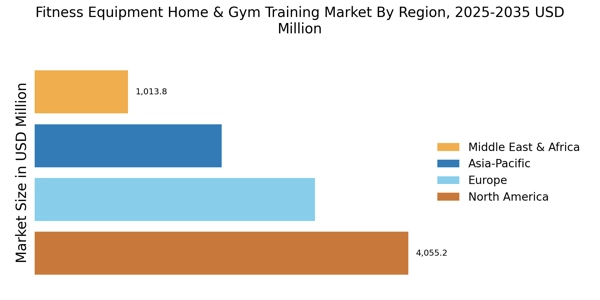
North America is the largest market for fitness equipment, holding approximately 40% of the global share. The region's growth is driven by increasing health awareness, rising disposable incomes, and a shift towards home fitness solutions. Regulatory support for health initiatives and fitness programs further catalyzes demand, making it a vibrant market for innovation and technology in fitness equipment. The United States leads the market, followed by Canada, with key players like Peloton, Nautilus, and Life Fitness dominating the landscape. The competitive environment is characterized by continuous product innovation and a focus on digital fitness solutions. The presence of established brands and a growing trend towards personalized fitness experiences are shaping the market dynamics.

Europe : Emerging Fitness Hub

Europe is witnessing a significant rise in the fitness equipment market, accounting for about 30% of the global share. The growth is fueled by increasing health consciousness, government initiatives promoting physical activity, and a surge in home gym setups. Regulatory frameworks supporting health and wellness programs are also contributing to this upward trend, making Europe a key player in the fitness equipment sector. Leading countries include Germany, the UK, and France, with a competitive landscape featuring brands like Technogym and Life Fitness. The market is characterized by a mix of established players and emerging startups focusing on innovative solutions. The demand for smart fitness equipment and connected devices is on the rise, reflecting changing consumer preferences towards technology-driven fitness solutions.

Asia-Pacific : Rapidly Growing Market

Asia-Pacific is rapidly emerging as a significant market for fitness equipment, holding around 20% of the global share. The growth is driven by urbanization, increasing disposable incomes, and a growing awareness of health and fitness. Government initiatives promoting sports and fitness activities are also acting as catalysts for market expansion, making this region a focal point for fitness equipment manufacturers. Countries like China, Japan, and India are leading the charge, with a competitive landscape that includes both local and international brands. The presence of key players such as Matrix Fitness and Cybex is notable, as they adapt to the unique preferences of Asian consumers. The market is characterized by a growing trend towards affordable and compact fitness solutions, catering to the needs of urban dwellers.

Middle East and Africa : Emerging Fitness Frontier

The Middle East and Africa region is gradually emerging in the fitness equipment market, accounting for approximately 10% of the global share. The growth is driven by increasing urbanization, a rising middle class, and a growing focus on health and wellness. Government initiatives aimed at promoting active lifestyles are also contributing to the market's expansion, making it a promising area for fitness equipment investment. Leading countries include South Africa and the UAE, where the competitive landscape is evolving with both local and international brands entering the market. Key players are beginning to establish a presence, focusing on high-quality and innovative fitness solutions. The demand for fitness equipment is expected to grow as more consumers prioritize health and fitness in their daily lives.

Fitness Equipment Home Gym Training Market Regional Image

Key Players and Competitive Insights

The Fitness Equipment Home & Gym Training Market is currently characterized by a dynamic competitive landscape, driven by a confluence of innovation, digital transformation, and evolving consumer preferences. Key players such as Peloton (US), Nautilus (US), and Technogym (IT) are at the forefront, each adopting distinct strategies to enhance their market positioning. Peloton (US) continues to leverage its strong brand identity and community engagement through subscription-based models, while Nautilus (US) focuses on diversifying its product offerings to cater to a broader audience. Technogym (IT), on the other hand, emphasizes high-end, connected fitness solutions, appealing to both commercial and home users, thereby shaping a competitive environment that prioritizes technological advancement and user experience.

In terms of business tactics, companies are increasingly localizing manufacturing and optimizing supply chains to enhance efficiency and responsiveness to market demands. The market structure appears moderately fragmented, with a mix of established brands and emerging players vying for market share. This fragmentation allows for a variety of consumer choices, while the collective influence of key players drives innovation and competitive pricing strategies.

In August 2025, Peloton (US) announced a strategic partnership with a leading health and wellness app, aiming to integrate their platforms for a more holistic fitness experience. This move is likely to enhance user engagement and retention, positioning Peloton as a comprehensive solution for fitness enthusiasts. Similarly, in September 2025, Nautilus (US) unveiled a new line of smart home gym equipment that incorporates AI-driven personal training features. This innovation not only caters to the growing demand for personalized fitness solutions but also reinforces Nautilus's commitment to technological advancement in the home fitness sector.

In July 2025, Technogym (IT) launched a sustainability initiative aimed at reducing its carbon footprint by 30% by 2030. This initiative reflects a broader trend within the industry towards sustainability, appealing to environmentally conscious consumers and enhancing Technogym's brand reputation. Such strategic actions indicate a shift towards integrating corporate social responsibility into core business strategies, which may resonate well with the modern consumer.

As of October 2025, the competitive trends within the Fitness Equipment Home & Gym Training Market are increasingly defined by digitalization, sustainability, and the integration of artificial intelligence. Strategic alliances are becoming more prevalent, as companies recognize the value of collaboration in enhancing product offerings and market reach. Looking ahead, it is anticipated that competitive differentiation will evolve, with a notable shift from price-based competition to a focus on innovation, technology, and supply chain reliability. This evolution suggests that companies that prioritize these aspects will likely secure a more sustainable competitive advantage in the future.

Key Companies in the Fitness Equipment Home Gym Training Market include

Industry Developments

November 2022 Trisport AG launched “HOI by Kettler” Frame Bikes curated for home sports fitness. It is designed in such a way that the frame of the bike resembles a racing bike and has a Bluetooth connectivity feature. The equipment is launched in three different models namely FRAME, FRAME+, and SPEED curated to different training requirements including endurance/competition training, high intensity cycling training, and intensive indoor cycle training, respectively.

November 2022 Nautilus launched two bikes under the Schwinn brand named Schwinn 290 Recumbent Bikes and Schwinn 190 Upright. The two bikes are designed in such a way that it has connectivity feature with the JRNY platform.

September 2022 Nautilus launched a new treadmill named Bowflex BXT8J that can be connected to the company’s fitness app. The company has priced the product in the affordable range to maximize sales in the home fitness sector. The product is made available to the customers through selected online retail sales channels.

September 2022 US Peloton has launched a rental scheme in the US market where customers can experience the Peloton Bike and Peloton Bike+ equipment at a monthly fee of USD 89 and USD 119 respectively across various locations in the US

May 2022 Technogym launched a Bio circuit system that provides personalized workouts and is made available for gyms in age care homes and retirement villages. The new bio circuit strength stations are launched in three modes namely prescribe mode which is aimed at trainers and psychotherapists; a free mode that is designed for supervised users and experts; and the goal mode which caters to unsupervised users and beginners.

February 2022 Technogym launched around 2,000 new on-demand video workout content that will be streamed on the Technogym Live Platform and in all equipment range that has a console. The launch is expected to help the company capitalize on the growing demand for digital fitness.

December 2021 GOGO Hervanta and Life Fitness have extended their partnership for the incorporation of the latest Health & Fitness Club of Hervanta. This incorporation will be the home of the extensive product range of Life Fitness such as brands such as Hammer Strength.

August 2021 Johnson Health Tech acquired its distributor of the company in South Africa, Matrix Fitness South Africa. With the acquisition, JHT has officially become the first company in the global fitness and equipment market to have an owned subsidiary in the African region.

July 2021 iFit Inc. acquired Sweat-the largest digital fitness platform for women across the globe USD 300 million.

January 2020 Dyaco announced the acquisition of Sole Fitness, a leading brand for exercise equipment headquartered in North America.

June 2019 Life Fitness announced the completion of the acquisition of the fitness brand Brunswick Corporation by KPS Capital Partners- a leading investment company based in the USA.

Future Outlook

Fitness Equipment Home Gym Training Market Future Outlook

The Fitness Equipment Home & Gym Training Market is projected to grow at a 5.86% CAGR from 2025 to 2035, driven by increasing health awareness, technological advancements, and the rise of home fitness solutions.

New opportunities lie in:

  • Development of smart fitness equipment with integrated AI coaching features.
  • Expansion of subscription-based virtual training platforms for personalized workouts.
  • Partnerships with health insurance companies to offer fitness equipment discounts.

By 2035, the market is expected to be robust, reflecting strong growth and innovation.

Market Segmentation

Fitness Equipment Home Gym Training Market Pricing Outlook

  • Premium/Luxury
  • Mass

Fitness Equipment Home Gym Training Market End User Outlook

  • Recreational
  • Professional

Fitness Equipment Home Gym Training Market Application Outlook

  • Residential
  • Commercial

Fitness Equipment Home Gym Training Market Demographics Outlook

  • Men
  • Women
  • Unisex
  • Kids

Fitness Equipment Home Gym Training Market Product Type Outlook

  • Cardiovascular Training Equipment
  • Strength Training Equipment

Fitness Equipment Home Gym Training Market Distribution Channel Outlook

  • Supermarkets & Hypermarkets
  • Specialty Stores
  • Online
  • Others

Report Scope

MARKET SIZE 2024 10138.08(USD Million)
MARKET SIZE 2025 10732.17(USD Million)
MARKET SIZE 2035 18967.34(USD Million)
COMPOUND ANNUAL GROWTH RATE (CAGR) 5.86% (2025 - 2035)
REPORT COVERAGE Revenue Forecast, Competitive Landscape, Growth Factors, and Trends
BASE YEAR 2024
Market Forecast Period 2025 - 2035
Historical Data 2019 - 2024
Market Forecast Units USD Million
Key Companies Profiled Peloton (US), Nautilus (US), Life Fitness (US), Technogym (IT), Bowflex (US), ProForm (US), Cybex (US), Matrix Fitness (US), Hammer Strength (US)
Segments Covered Application, Region
Key Market Opportunities Integration of smart technology enhances user engagement in the Fitness Equipment Home & Gym Training Market.
Key Market Dynamics Rising consumer demand for home fitness solutions drives innovation and competition in the fitness equipment market.
Countries Covered North America, Europe, APAC, South America, MEA

Market Highlights

FAQs

What is the current valuation of the Fitness Equipment Home & Gym Training Market?

The market valuation was 10138.08 USD Million in 2024.

What is the projected market size for the Fitness Equipment Home & Gym Training Market by 2035?

The market is projected to reach 18967.34 USD Million by 2035.

What is the expected CAGR for the Fitness Equipment Home & Gym Training Market during the forecast period?

The expected CAGR for the market from 2025 to 2035 is 5.86%.

Which product types dominate the Fitness Equipment Home & Gym Training Market?

Cardiovascular Training Equipment and Strength Training Equipment are the dominant product types.

What were the market values for Cardiovascular and Strength Training Equipment in 2024?

In 2024, Cardiovascular Training Equipment was valued at 4041.0 USD Million, while Strength Training Equipment was valued at 6097.08 USD Million.

How is the Fitness Equipment Home & Gym Training Market segmented by application?

The market is segmented into Residential, valued at 6060.0 USD Million, and Commercial, valued at 4078.08 USD Million.

What demographic segments are represented in the Fitness Equipment Home & Gym Training Market?

The market includes Men, Women, Unisex, and Kids, with respective values of 3034.82, 2534.08, 2034.08, and 2034.1 USD Million in 2024.

What pricing segments are present in the Fitness Equipment Home & Gym Training Market?

The market features Premium/Luxury and Mass pricing segments, valued at 3034.82 and 7103.26 USD Million, respectively.

Which distribution channels are utilized in the Fitness Equipment Home & Gym Training Market?

Distribution channels include Supermarkets & Hypermarkets, Specialty Stores, Online, and Others, with respective values of 2027.23, 1520.0, 4041.85, and 3548.0 USD Million.

Who are the key players in the Fitness Equipment Home & Gym Training Market?

Key players include Peloton, Nautilus, Life Fitness, Technogym, Bowflex, ProForm, Cybex, Matrix Fitness, and Hammer Strength.

Author
Author
Author Profile
Snehal Singh LinkedIn
Manager - Research
High acumen in analyzing complex macro & micro markets with more than 6 years of work experience in the field of market research. By implementing her analytical skills in forecasting and estimation into market research reports, she has expertise in Packaging, Construction, and Equipment domains. She handles a team size of 20-25 resources and ensures smooth running of the projects, associated marketing activities, and client servicing.
Leave a Comment
Download Free Sample

Kindly complete the form below to receive a free sample of this Report

Compare Licence

×
Features License Type
Single User Multiuser License Enterprise User
Price $4,950 $5,950 $7,250
Maximum User Access Limit 1 User Upto 10 Users Unrestricted Access Throughout the Organization
Free Customization âś“ âś“ âś“
Direct Access to Analyst âś“ âś“ âś“
Deliverable Format âś“ âś“ âś“
Platform Access âś— âś— âś“
Discount on Next Purchase 10% 15% 15%
Printable Versions âś— âś— âś“